Are Naomi Klein and Astra Taylor right to call this “end times fascism”?
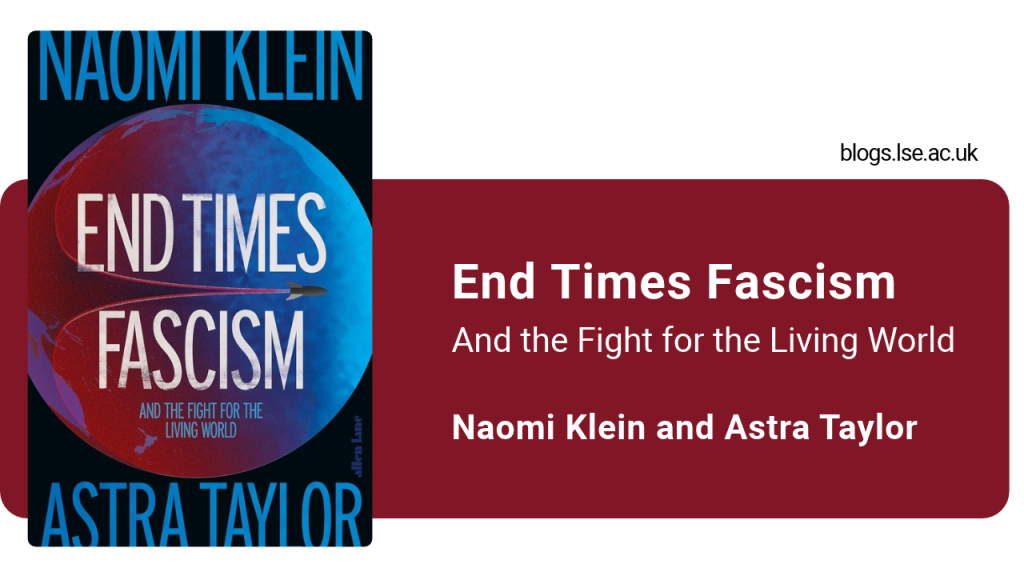
End Times Fascism by Naomi Klein and Astra Taylor argues that a new, insidious fascism has emerged through far-right politics, AI and billionaire power, and sets out what we can do to fight these forces.
Though brilliantly written and compelling, the book’s US focus and merging of various issues under the fascism umbrella is limiting, writes Danny Dorling.
A new dark age of fascism?
End Times Fascism begins with a modern Sermon on the Mount. The mount is nestled between mountain tops within the small Swiss town of Davos, and the sermon is being given by two envoys of Donald Trump. The future they lay out is for a “New Gaza”. They describe this as Trump’s vision, a strip of luxury hotels with biometric security for the Palestinian workers who would maintain them, clean them, and serve in them. Notably, it has space for far fewer Palestinians than currently still survive in the strip. One of Trump’s two envoys, his son-in-law Jared Kushner, calls it planning for “catastrophic success”. The authors of this book call it fascism.
Naomi Klein and Astra Taylor are global authorities on diagnosing the world’s ills and making rallying cries to combat them. Taylor’s much-lauded 2023 book The Age of Insecurity exemplifies this work, as does Klein’s No Is Not Enough (2017). Together they form a formidable writing pairing to contribute to the slew of books in the vein of doomsaying political commentary in recent years, mostly written by men. Notable examples include Anton Jäger’s Hyperpolitics: Extreme Politicization without Political Consequences and Omar El Akkad’s One Day, Everyone Will Have Always Been Against This, both from 2026. But there is also a limitation to all these books when the authors share such similar perspectives.
By concentrating on the very worst that is happening around the world, and mostly on the US, the implication that many readers may draw is that we are likely doomed.
End Times Fascism is organised into four parts and nine chapters. These four sections cover the end-of-times thinking of the far right (“messianic dreams”), AI (“escape to the cloud”), profiteering from chaos (“prepper nation”), and what can be done (“Let’s stay”). It sets out to convince the reader that our time are dire – as bad as the 1930s but in a different way. This difference is perturbing and insidious: there are so many different types of fascists now, few of whom goose-step or wear uniforms. But the book does not aim to convert opinions, instead assuming its readers are already sympathetic to the anti-fascist cause.
It preaches to the choir well, is fast-moving and brilliantly written. However, by concentrating on the very worst that is happening around the world, and mostly on the US, the implication that many readers may draw is that we are likely doomed. The authors steer clear of mentioning where in the world various aspects of life are improving, where peace, stability and concerns for all people and the planet have strengthened. Examples of these include the decline in violence over the last two decades in countries such as the UK and increases in recycling, including of objects as large as container ships (over a third of which now occurs in India).
How fascism operates today
The global balance has shifted towards fascism and the small rebel alliance opposing it is struggling, according to Taylor and Klein. Fascism is defined in this book as “a revolt of the strong or relatively strong and injured that, while antidemocratic, taps into powerful popular passions and resentments” (9). The definition is vague, attempting to amalgamate many current movements and trends under one label. On page 31 alone the list ranges from promoters of cryptocurrencies to energy drinks, advocates of facial-recognition-databases, and “fascism’s past victims mimicking their victimizers and calling it freedom”. It begs the question of whether such a catch-all approach is analytically useful.
The authors quote Umberto Eco’s observation that fascists always appear to be seeking a “final battle, after which the movement will have control of the world.” But the trope of a “final battle” to come is also strengthened by books like Klein and Taylor’s. The alternative is to envisage a continuous struggle. To paraphrase from the 1998 song “The Day the Nazi died”: the Nazis never went away. Fascism has been with us for a century now; it is a constant battle. Labelling today as the “end times” may therefore be misleading. We lack an agreed metric to measure the success and failings of those who seek to promote fascist ideas. If it is the rise of far-right political parties, we keep in mind that they can fall in popularity and that countries can veer rightwards and back again in short order.
Is this really the end of times?
Is today’s world more dangerous than it has ever been, as the authors claim? Globally, war deaths are far below the levels they were decades ago. Despite increased climate-related disasters, fewer people now die in them. We have never had a world in which so many people are literate and in which such a high proportion of children survive into adulthood (although progress is now slowing) and we now worry about ageing societies. Food crises and deaths from famines being at historic lows and that for most people in most countries in the world, living standards are still improving markedly, not least as fewer and fewer children are born into poverty as the numbers of children we have, especially in the poorest of families, plummets. The book concludes that in comparison to the 1960s, “our world today is beset with more apocalyptic threats….”. But most of those threats existed in the 1960s, such as climate change and even AI, and the era had its own threats (not least the Cold War).
To combat the fascism of our times [the authors propose] public ownership of AI, the redistribution of the lion’s share of the wealth of billionaires and nuclear disarmament
What do the authors propose we do to combat the fascism of our times? Among much else is public ownership of AI, the redistribution of the lion’s share of the wealth of billionaires and nuclear disarmament so that no future tyrant has nuclear weapons. These aims are no more fanciful than campaigns in the past were to make slavery illegal, treat women as equal humans, make the provision of necessities such as water, energy, healthcare, education and housing public goods. In many places this has been achieved, and often there is still progress, but rarely through sudden, seismic political shifts; rather, they were eked out over time through gradual reforms.
Hope in a more global perspective
The authors rightly cite the United Nations and the International Criminal Court as part of our hope for the future. These bodies offer the possibility that the fascists will one day face judgment, but this is not a fast route to salvation – there may be no shortcut. They suggest the UN needs to be reinforced and democratised, and that the five permanent members of the security council should have their veto power abolished. Given so many recent votes in the UN against the wishes of the US, and supported by most countries worldwide, there is perhaps some hope here that countries representing the majority of people on earth might declare their majority. But India and China, the most populous nations, would have to agree on much more than they currently do.
A more diverse, global perspective on the crises of our moment and the solutions to them seems the best chance at surviving and building beyond the ‘end of times’.
India is listed just once in the book’s index, China, not at all. Neither is the continent of Africa, or its most popular states of Nigeria, Ethiopia or Egypt. In contrast, Israel has two dozen entries, the USA slightly more, the UK nine, Germany four, France three, Norway two, Switzerland one. Most European countries get no mention, even Canada is only mentioned twice. So, despite its invocation of all “the living world” in its subtitle, End Times Fascism is overwhelmingly a book about the US (home to just four per cent of the global population) and its satellite states and closest allies. (The election of New York’s new mayor, Zohran Mamdani, is proffered as a sign of new hope, implying that we should look inside the US for the solution to our problems.)
The book is well-written, highly engaging and an insightful examination of our times, all of which make it a worthwhile read. My main concern, reading it in Europe and thinking about the rest of the world, is that the book’s concentration on the US and Trump gives them too much power and limits the vision for resistance. A more diverse, global perspective on the crises of our moment and the solutions to them seems the best chance at surviving and building beyond the “end of times”.
For a PDF of this publication and where it was originally published click here.