Nationalisation back on the table
On the 25th of September 2026, three writers at the Institute of Fiscal Studies (IFS) published a paper asking the question: “Should utilities such as water, energy and transport come under public control? In deciding, the government needs to confront important trade-offs.” The report was titled ‘Nationalisation and public control: costs, opportunities and trade-offs’(1). So, what did the report say and with what possible consequences?
The report began by pointing out that the UK government already regulates the water, energy and transport utilities extensively. In Scotland, water is already nationalised. In Northern Ireland, both water and buses are provided and run directly by the state. There is no need for private-sector involvement on the scale found elsewhere, and these survivors (from our far more nationalised past) serve as examples of what may soon become more normal again.
The spread of nationalisation can already be seen in rail, which is now under full public control in Wales and Scotland, while no franchises coming up for renewal in England are being awarded to private rail companies. Instead, as the IFS report points out, ‘The Railways Bill currently going through parliament will consolidate the UK government-operated franchises into a single, publicly owned company, Great British Railways. In this case, the overriding aim of greater public control is to produce more integrated and efficient – and therefore cheaper – rail services.’ When it comes to rail, as with so many of the other privatisations of the 1980s, the experiment failed.
Worst of both worlds?
As consumers and taxpayers, we pay both for shareholders to profit and for the work of government regulation. What the IFS report didn’t say is that this may be a costly worst-of-both-worlds scenario. Our taxpayers’ money pays for the people employed by state regulators and for the negotiations between private companies supplying our water and the government agencies responsible for agreeing their business plans. For example, the government energy regulator ‘Ofgem’ sets an energy price cap using the work of civil servants, in theory only allowing for a small profit margin for the private shareholders. The great incentive for the private company, of course, is to try to find ways of circumventing these controls. If they cannot raise prices, they can provide a poorer service. If they do that, they may be fined, but the fines are, in the end, paid by their customers.
It is not just the three utilities of water, energy and transport that have these complicated arrangements in place. Government regulates local authorities and housing associations to cap the amount by which social rents can rise each year. Since May 2026, they have begun to do the same for rents in the private housing sector, so far only in a very loose way – but this has already had the effect of some private tenants no longer being required to pay several months’ rent in advance. As government regulates more, the question beginning to arise is: why does the government not simply provide the service itself, since it is doing more and more of the work of organising how these utilities and public goods are priced and delivered?
The argument that is usually made is that ‘the market is more efficient’. Thus, we have public transport provided by buses and trains, where private companies bid every so often to be allowed to provide the service for a number of years under strict criteria. But why, then, tolerate private companies making a profit if what they do is so controlled that they cannot innovate? Why have that extra shareholder cost? In London, the bus service has been franchised for over 30 years. It works, but it could be argued that directly nationalising the buses would have been cheaper. However, when the London franchises began in 1995 (towards the end of the Thatcher-Major era), such a suggestion would have been greeted with horror. Renationalising was never seriously addressed by the Blair-Brown governments, or by all their predecessors. But in recent years and months, the mood has changed abruptly.
Today is different
Bus franchising schemes similar to London’s have been operating in Greater Manchester since 2023, and the IFS report details how these schemes are to be expanded to much of the rest of the North West of England as franchising begins in the Liverpool city region, with similar developments in the West Midlands and Wales. No doubt the major private bus companies of the UK are worried about the direction of travel. While they continue to be paid subsidies to run public services, they may remain sanguine. But they will be aware that in July 2026, the government fully nationalised British Steel in what could be seen as a test case to determine the actual legal ramifications. Thames Water, which supplies a quarter of England’s population with water and sewerage services, could at any time be taken into a ‘Special Administration Regime’ as it falters over providing basic services in particular places at particular times, releases far more sewage into rivers than it agreed to, and has built up huge debts.
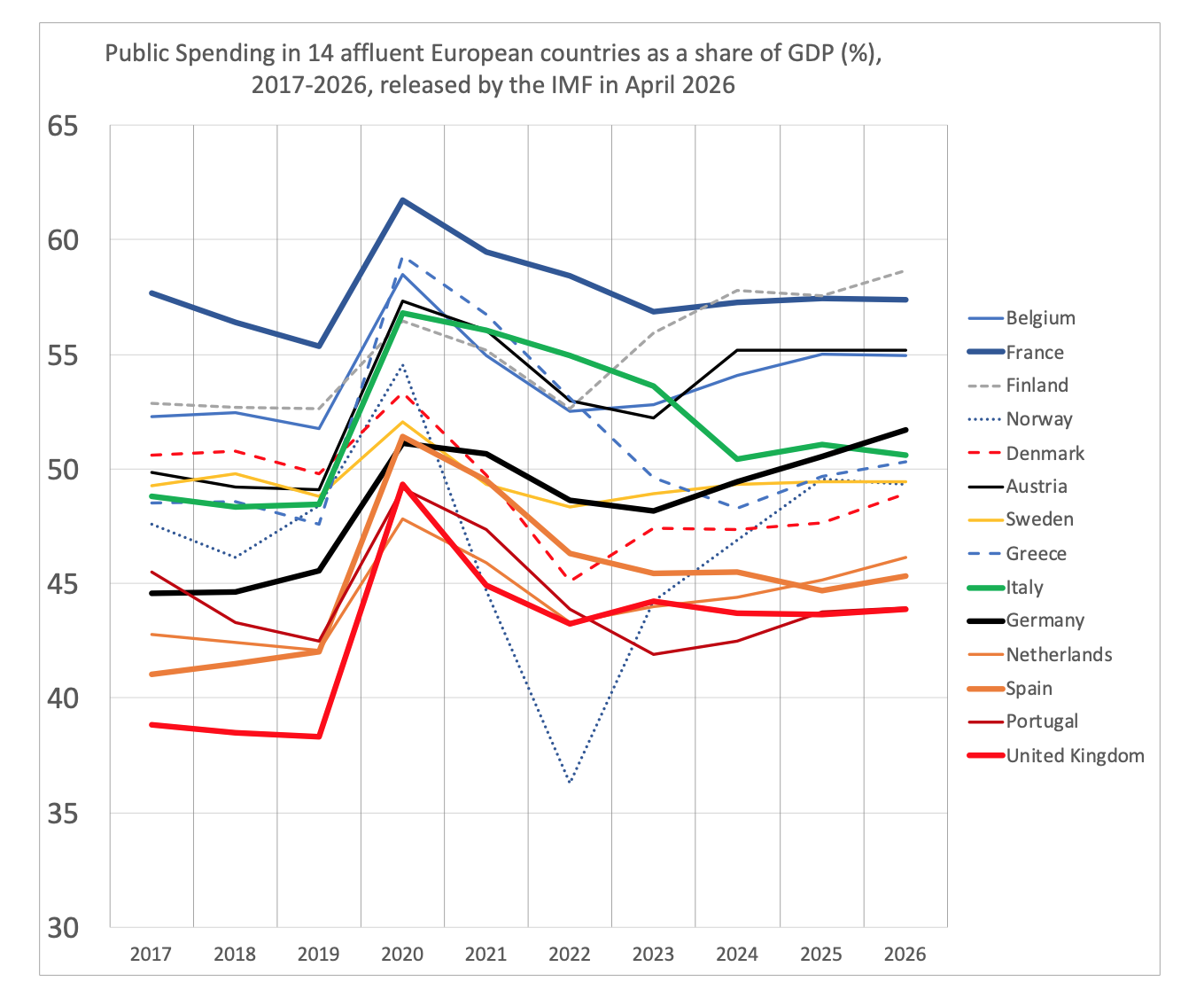
Oddly, one of the main reasons given to oppose nationalisation, or even greater regulation, is that the utility would then be included in the headline statistical measures of public ownership. I say ‘oddly’ as the UK in 2026 ranks at the bottom of the league table of European nations in terms of public ownership and spending(2). The IFS report states that ‘Given how consequential this classification can be, the government may be tempted to carefully design measures to increase public control that do not cause the ONS to reclassify what is in the public sector.’ But is this as consequential as Thames Water building up such a great private debt?
The graph shown here demonstrates how much public spending has varied over time and between 14 European countries in recent years. I show the same countries I have tracked before. Spending rose in all countries with the onset of the pandemic in 2020, but subsequently fell to varying degrees. The fall was particularly sharp in Norway, which was less affected by the pandemic than other countries. However, spending there has since returned to almost 50% of GDP, although it is now lower than in six other countries. By 2026, the UK remained the lowest-spending country on public services. Spending includes everything from defence to servicing public debt, as well as the usual health, housing and educational commitments. The UK figure is now 44%. If people pay the government more, and private providers less, they can receive better services.
The UK still spends less on public goods than most comparable countries
The UK still spends less on public goods than most comparable countries
Source: https://data.imf.org/en/DataExplorer?datasetUrn=IMF.RES:WEO(9.0.0)&INDICATOR=GGX_NGDP
How much will it cost?
A key question is always compensation. For example, even when rail franchises are taken back into public control, the rolling stock – the trains and carriages – are usually still being leased from private companies. If the rolling stock were to be nationalised, the companies would take the government to court if they did not think they were paid fairly for this, including resorting to ‘international arbitration’ if the owners are overseas.
The IFS authors point out that ‘If compensation is too low, other investors may fear the risk of nationalisation below fair value in future, and hence be discouraged from investing or owning property in the UK’. What they do not say is why the people of Britain should want this property to be owned by others. You would not wish the chairs, sofas and tables in your sitting room to be owned by someone else and leased to you at an annual rate. Why, then, should you want the same for the pipes that take water to your home and the sewage away, or the public-sector vehicles you travel on, or your electricity supply, your gas, all the basics where ‘shopping around’ is actually an annual and unnecessary chore that serves only to make a few shareholders richer while maintaining a pretence of saving you money?
Opportunities
One of the arguments for nationalisation is that the utilities we are concerned with are already natural monopolies and based on an infrastructure too large for any private company to maintain efficiently. The temptation for private providers to try to raise prices and lower their costs continuously is just too great, especially where there is currently the least regulation. Think of your monthly internet bill as an example of this profiteering.
How might nationalisation work, and how much should we expect? The government has borrowing rules that it uses to limit its own actions. However, the IFS points out that: ‘If much of the costs of the organisation taken into the public sector are investment costs, the effects on the borrowing rule, which targets the current budget, will be smaller than if the costs are mainly day-to-day costs.’
The IFS authors concluded their report by stating that ‘…it is important that decisions are not made solely on the basis of the fiscal rules. If the details of statistical classification and the measures used for the fiscal rules become the guide for government decisions on public control, economic outcomes will be poorer for it and the credibility of the fiscal rules will be diminished.’ Nationalisation is back as a serious option. A reversal of 1980s thinking is underway.
References
1 https://ifs.org.uk/articles/nationalisation-and-public-control-costs-opportunities-and-trade-offs
2 https://data.imf.org/en/DataExplorer?datasetUrn=IMF.RES:WEO(9.0.0)&INDICATOR=GGX_NGDP
To view this post as a PDF and where this commment was orignally published, click here.