Addressing right-wing bias in the BBC
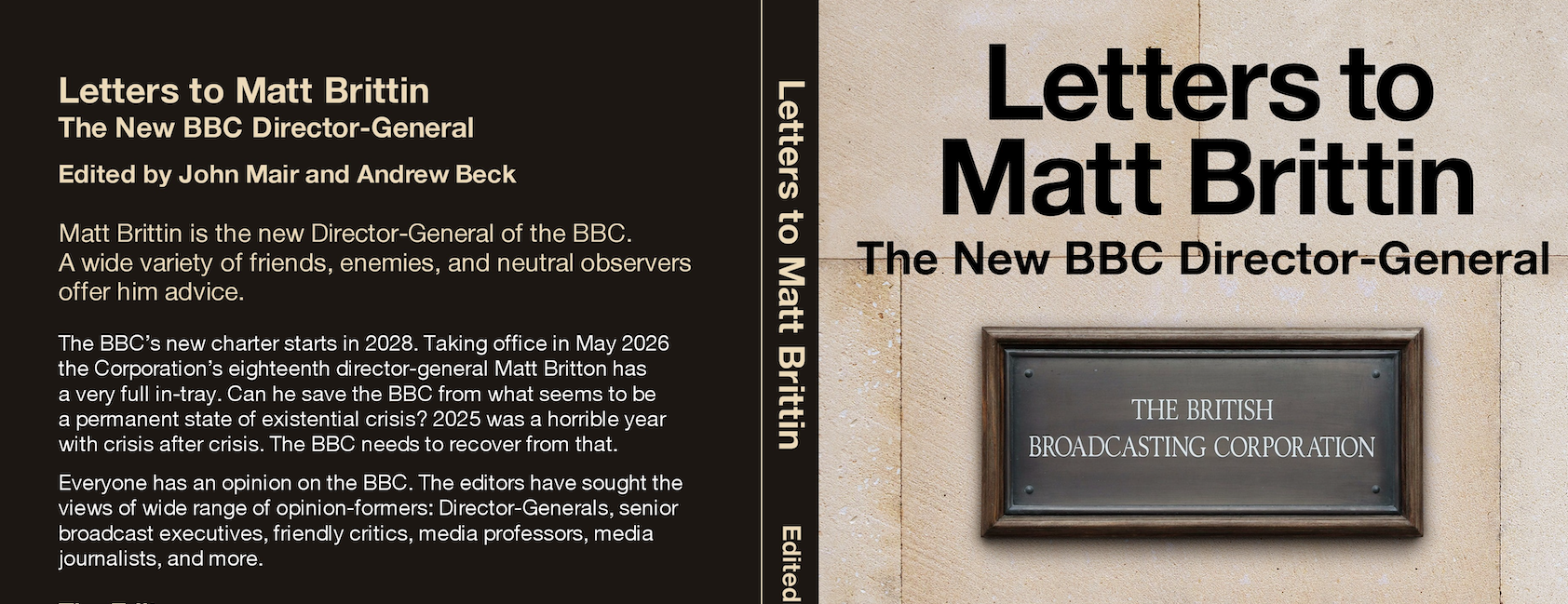
Danny Dorling urges the new Director-General to recognise that for most of the world outside the UK the BBC appears to be an organ of right-wing propaganda—and how they might solve that
Dear Matt Brittin,
Congratulations on your appointment. Hold tight. There are many issues you will need to address in your new job, but a priority should be how your organisation is seen politically by the wider world. Not least because that impacts how it is viewed within the UK too.
The UK is a politically right-wing country. At one point in recent years the Financial Times published research demonstrating that the political parties of the UK favoured economic policies that were far to the right of global norms. In 2022 the Conservative party was deemed to be the single most right-wing of all the main political parties in all the rich and mainstream world states. On 30 September 2022 that newspaper ran this story under the headline ‘The Tories have become unmoored from the British people’. However, many of the British people then moved even further to the right, supporting for the far-right political party Reform UK.
The British Conservative party left the European Conservative block in 2014 as its views no longer aligned with normal European Conservatives. It has been moving rightwards ever since Mrs Thatcher abandoned One Nation Conservativism in the 1980s. The Labour party similarly moved rightwards to no longer be a normal European Social Democratic Party after New Labour took hold in the 1990s. When Jeremy Corbyn was leader, its 2017 and 2019 manifesto commitments were to increase public spending, although not quite to the levels of a country like Germany, spending achieved under Angela Merkel, a mainstream European Conservative. When the Lib-Dems were in government in coalition with the Conservatives from 2010 to 20215 they agreed with polices raising student fees higher than any other European country.
Whenever the BBC gave Nigel Farage an enormous amount of air time it was often criticised for doing so, but it could be argued that it was simply reflecting the will of some of the UK population. That in doing this the BBC aided those who had put their money into supporting Farage was unfortunate, but it was understandable given both who was appointed to make BBC policy and the underlying ethos of trusting the electorate, and trusting those who manipulated the electorate with their money. In The Blind Spot: How Oligarchs Dominate Our Democracies the American political scientist, Jeffrey Winters, explains how a similar process has taken place in the USA. It is ironic that a Reform UK government might mean the end of the BBC.
During its heyday the BBC was fortunate to be the public service broadcaster of a country that was unusually progressive by global norms. Britain had established the most successful National Health Service, the most comprehensive education system in the world, and provided better quality and quantity of social housing for its citizens than any other state in the 1950s and 1960s. Being politically neutral at that time meant both celebrating these successes and querying what was still possible. The BBC produced globally cutting edge arts, comedy and children’s programming at this time with more confidence and within a very different ethos than today.
Britain is now a European outlier, politically, socially, and economically. It has the highest income inequality in all Europe apart from Bulgaria. The rich are richer in Britain and the poor much poorer. The poorest fifth of the UK’s population now have lower standards of living than the poorest fifth across Eastern Europe. In most other European countries economic divisions have fallen slightly in recent years. They were lower to begin with. The UK has experienced the greatest increase in child poverty among all the countries that the United Nations compares. The BBC has been tasked with producing heart-warming stories from the regions. To the outside world this looks like propaganda.
When you present a state that is no longer normal as normal, it can look as if you are lying. People in the UK who have lived in other countries see this, as do those who are aware that the same stories are told in very different ways by the media in other countries. For example, presenting issues such as whether a basic good such as water should be provided by profit-making companies looks odd to those who know it is usually provided by the state as a basic service. Having an underlying ethos of presenting the market being optimum makes BBC economic coverage look cultish to many outsiders as well as to many British people, especially those living in Scotland where the privatisation of goods such as water or university education has been successfully resisted.
It is when the BBC reports on international affairs that it risks looking most partisan and biased. In recent years the UK has become an international outlier, not simply in terms of its very high internal economic divisions, but also in the stances it takes on often voting with the United States and a few other countries in the United Nations, as well as taking part (or tacitly supporting) actions which either are, or may soon be, defined as illegal by the International Criminal Court in The Hague.
When the politicians of a country have decided to side so heavily with an extreme position, its public service broadcaster has a problem. The BBC was banned from reporting in China in February 2021. The corporation said it was ‘disappointed’. The question to be asked was whether China or Britain had become more extreme. The British Foreign Secretary, Dominic Raab at the time, called the move an ‘unacceptable curtailing of media freedom’. A year later Britain banned the state-backed Russia Today from reporting in Britain.
The BBC’s motto, ‘Nation Shall Speak Peace Unto Nation’, was adopted in 1927. In February 2021 when the BBC was banned from speaking to 1.4bn people in China it suffered a great blow. More importantly, since then its international audience has fallen further, dropping to 450m people viewing it in an average week in 2024, and then down to 418m a week in 2025. The corporation revealed these drops under the headlines ‘BBC’s global audience holds firm despite increased competition’ and ‘BBC’s response to global news events drives audience growth’. Describing a fall as growth looks like lying—from ‘the most trusted international news provider’.
How can you get out of this impasse? Be honest. It is very hard to be honest, but when fewer people are watching your international news service, say that with your headline. Take a long hard look at yourself. Ask how many minutes are spent reporting the deaths of people whose skin colour is not white around the world because that bias becomes more obvious as the UK becomes more diverse. Be brave. Be different. The alternative is to become increasingly irrelevant and distrusted. In a world where news is increasingly fabricated there is a hunger for trusted sources, but the BBC is living off the goodwill of a legacy built up when it was based in a country that was far more representative of more neutral political positions.
It may be too late. The corporation might well be privatised in coming years, sold off to the highest bidder to help balance the state’s books for a year. Or it could begin to rebuild its reputation. To do that it needs to think carefully about the language it uses.
On 12 February 2026 the BBC published an obscure podcast under the headline ‘Climate boost as China’s CO2 emissions fall’ with the summary being ‘China’s carbon dioxide emissions fell for the first time in 2025. The decrease was marginal but has raised hopes that the world’s biggest emitter has reached a turning point.’ Imagine how the BBC would have reported that information had the country in question been India.
Imagine if it reported how much fewer emissions were per person in China than in the UK, and how much higher per person in the USA. It would take millions of small editorial decisions to begin to tell stories in such a way that the increasingly sophisticated global audience would decide to tune in more, or be allowed to tune in at all. It is possible. It is probably unlikely.
Yours sincerely
Danny Dorling
For A PDF of this capter and where it was originally published click here.
[Dorling, D., ‘Addressing right-wing bias in the BBC’, Chapter 13 in John Mair and Andrew Beck (Eds.) ‘Letters to Matt Brittin: The new BBC director-general’, Oxford: Bite Sized Books.]