The billionaires, the middle men, and the little people
The year 2026 began with revelations that a former cabinet minister, Peter Mandelson, appeared to have passed on sensitive information including economic policy plans from the UK government to the financier Jeffery Epstein. A police investigation is underway. As the BBC put it: ‘Emails released by the US Department of Justice (DoJ) appear to show Lord Mandelson forwarded information to Epstein when he was business secretary under former Prime Minister Gordon Brown in 2009.’ Several commentators implied they were not at all surprised. As yet we do not know to whom that 2009 information may have been passed on to by Epstein. We do not know what the information may have been used for. The situation is presented as being opaque.
Peter Mandelson will not be the only one. He stands out because he was caught. Jeffery Epstein will not be the only financier soliciting information of this kind. He stands out because he was also caught, for other heinous crimes. The UK will be one of many countries where information is passed from politicians and government officials to people in finance to give them an inside edge to make even more money from ‘their’ money.
More will be revealed in the months and years to come, but attempts will also be made, as they always are, to suggest that this is a rare occurrence of just a few ‘bad apples’. However, this time is different. It is different because the aggregate effect of all the profiteering is now coming home to roost, including on those of us who used to be ‘comfortable’, and we are feeling the effects and looking for answers as to who is to blame.
Peter Mandelson was appointed by Labour Leader Neil Kinnock to be the party’s Director of Communications in 1985 and worked on its 1987 General Election campaign; an election which Labour lost despite the Conservatives having such a poor record. But Mandelson rose up the ranks nevertheless. From the 1980s onwards he interacted closely with the leadership of the Labour party, except for when John Smith and Jeremy Corbyn were leaders. They both shunned him. Mandelson was influential in promoting people who later trusted him and worked closely with him. He promoted Tony Blair to be leader of the Labour party. Blair appointed him to be Labour’s election campaign director for the 1997 general election. Labour won, but what then actually changed?
When Labour took over from the Conservatives in 1997 there was an optimism that reform was afoot. However, it is worth remembering that the Labour Party had become more skilled at communicating, primarily under Mandelson’s direction. progress was mostly illusionary. For most people their lives changed very little. Income inequality carried on growing after 1997, the country became more unequal geographically. There was a reduction in child poverty, but it was so small that it did not result in even the slightest decrease in the income inequality statistics. The families of around a million children slipped briefly just above an arbitrary poverty line having been just below it. More are now below that line again today.
As Figure 1 shows, the cost of living was rising all the time, the figure shows the Retail Price Index (RPI) which includes housing costs. More and more families were having to rent privately. Rents were not controlled or regulated in any way. For people whose incomes were rising above the rate of RPI, they were becoming better-off, but they were a minority of the UK population. For those whose incomes were rising more slowly (or falling), the relentless increases in the prices of goods, services, privatized utilities such as water and fuel meant that they were their living standards were not improving at all. This was most obviously the case when the price of housing was also taken into account, which tended to be highest for families with young children.
Figure 1: Inflation in the UK 1987-2025
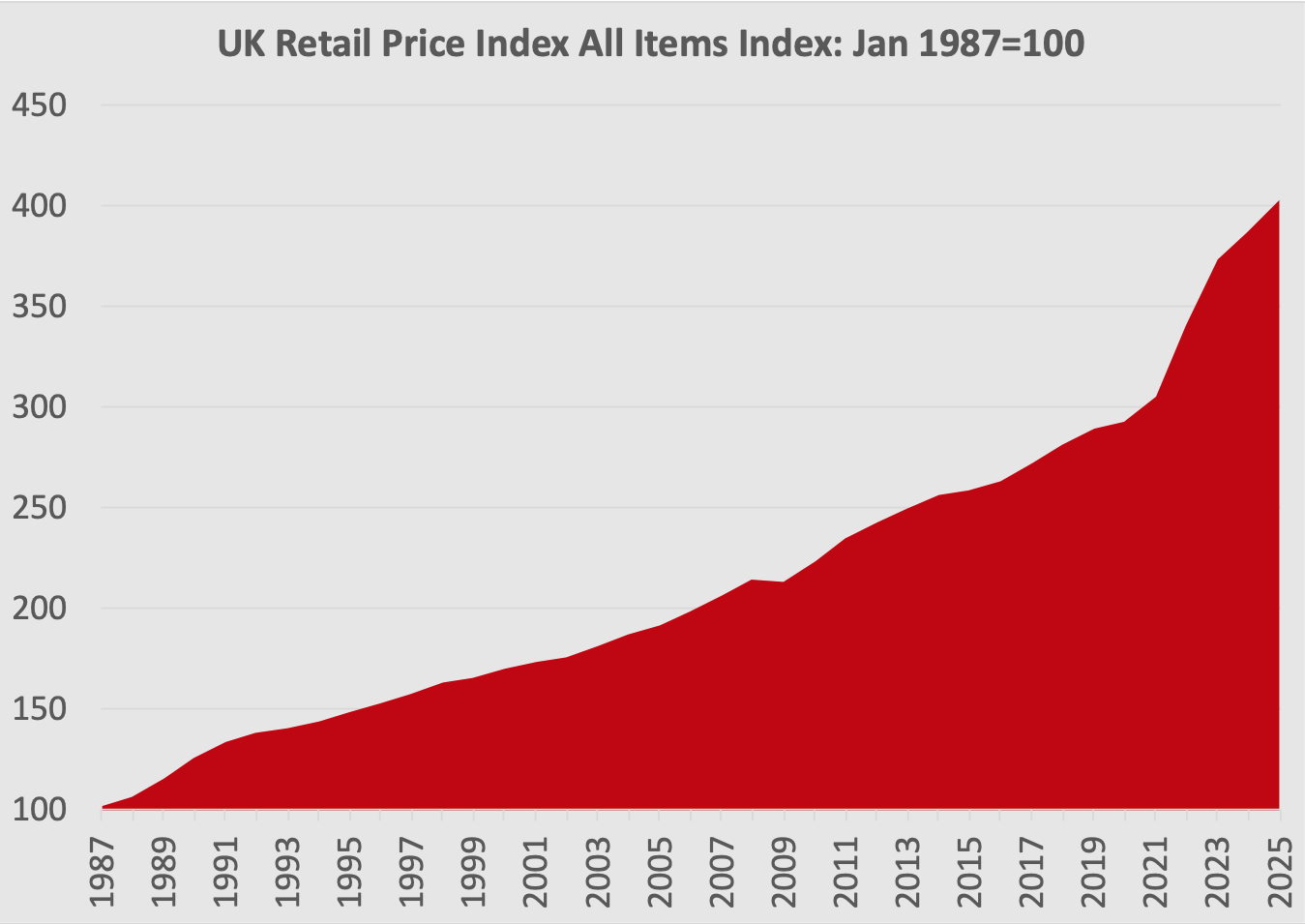
Inflation in the UK 1987-2025
Source: https://www.ons.gov.uk/economy/inflationandpriceindices/timeseries/chaw/mm23
The more we discover about who politicians are actually working for, the better we can understand their motives. Many, upon retiring from political office, go on to work in or advise the financial service industry. There will be attempts to present this as not being a conflict of interest. The extent to which it is possible to paint a picture of just a few ‘bad apples’, will determine how long such attempts continue to be successful. Those attempts become ever more desperate. How will today’s ‘directors of communications’ manage to keep pulling the wool over peoples’ eyes when the times and circumstances have changed so much from what was the case in the 1990s?
There was a brief hiatus in the relentless rise in prices in 2008. But it was very brief, as Figure 1 reveals. The banks were bailed out with little consequences for those who ran them, thanks partly (we now learn) to the access financiers had to politicians worldwide. Prices rose from 2009 onwards, and very quickly in the 2020s with the cost-of-living crisis. As yet there are no signs of any adjustment downwards. Why would there be? A correction to prices would require government interventions. These are communicated as being ‘impossible’ because they would interfere with ‘markets’, telling a story as if the selling of insider information and collusion never happened. ‘There is no money’, they lie to you.
In January 2026 Oxfam released its annual report on the wealth and power of the richest people on the planet, the now three thousand billionaires. Oxfam revealed that in 2025 the billionaires’ wealth had risen by 16 per cent in real terms in just one year. This rise was three times faster than the past five-year average increase. It took their wealth to $18.3 trillion – its highest level in history. The report was titled ‘Resisting the Rule of the Rich: Protecting Freedom from Billionaire Power’. Figure 2 is taken from that report. It shows that there is a huge amount of money; but it is increasingly held by just a few people. People with access to information and power.
Figure 2: Billionaires’ Wealth 1987-2025, US$ billions (real terms)
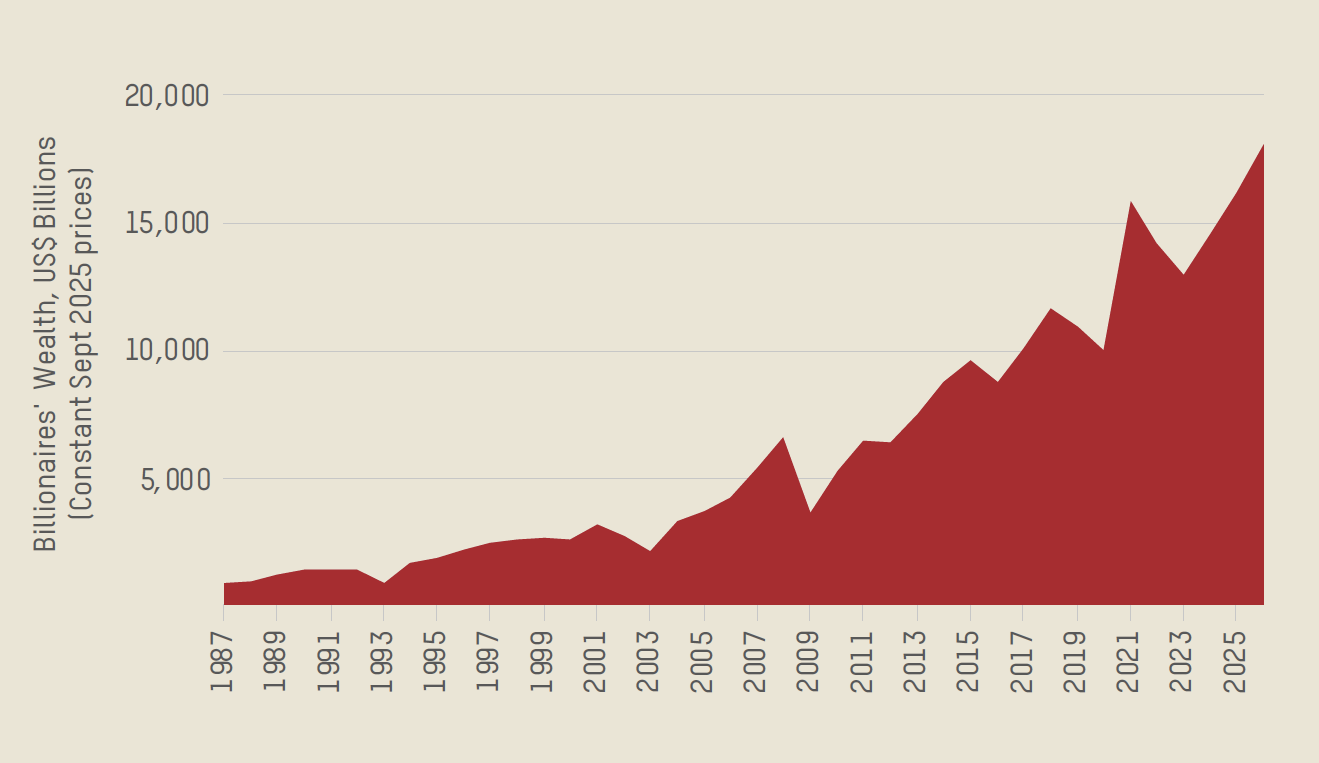
Billionaires’ Wealth 1987-2025, US$ billions (real terms)
Source: https://www.oxfam.org/en/research/resisting-rule-rich
Oxfam took a global view. Their researchers showed that the collective wealth of the billionaires in 2025 surged by $2.5 trillion, which they explained was almost equivalent to the total wealth held by the bottom half of humanity – some 4.1 billion people. They explained that the richest of them, Elon Musk, now held over half a trillion dollars; that billionaires were now 4000 times more likely to hold political office than ordinary people; and that just the $2.5 trillion rise in the billionaires’ wealth alone would be enough to eradicate extreme poverty worldwide some 26 times over, if that rise could somehow be diverted.
Oxfam’s Executive Director, Amitabh Behar, was quoted upon the release of their 2026 report as saying: ‘Governments are making wrong choices to pander to the elite and defend wealth while repressing people’s rights and anger at how so many of their lives are becoming unaffordable and unbearable’. The reported hinted at the many ways in which billionaires gain influence: Jeff Bezos’ purchase of the Washington Post, Elon Musk’s ownership of Twitter/X, Patrick Soon-Shiong controlling the Los Angeles Times, a billionaire consortium buying large shares of The Economist; the far-right billionaire Vincent Bolloré now controlling CNews and rebranding it as the French equivalent of Fox News. While in the UK, some three-quarters of all the newspapers circulation are controlled by four super-rich families; and the President of the United States attempts to sue the BBC.
The billionaires are clearly very frightened. They would not be spending so much of their money on trying to control communications if they were not. They fear what happens when tens, if not a few hundreds, of millions of people who were well-off, who live mostly in affluent countries, now also face a rising costs-of-living, living on lower real incomes? Those below the middle-men have a declining share of wealth and a growing unease that they – and their families – are unlikely to avoid precarity in future. The billionaires answer, as always, is to try to divide and rule, to keep ruling; to promote fear of immigrants and others.
Your government works ‘for you’ is the message they would like you to believe. When it is revealed that is has not been, that has to be painted as a one-off, an aberration. But there will be many others, like John Smith and Jeremy Corbyn, mostly women, who will not be tainted by association. It is time we realised what will happen if we do not carefully distinguish between the middle-men working for themselves and their real masters, and the rest of our politicians. Some of them are good.
For the source of the original publication, and a PDF of this article, click here.