The strains are showing in a previously stable political system
The UK’s deepening inequalities are no longer just an economic problem but are reshaping politics, undermining trust, and widening generational divides. These growing strains are becoming increasingly visible in what was once one of the world’s most stable political systems.
In her conclusion to a review of three books on the state of the UK in early 2026, Diane Coyle, the Bennett Professor of Public Policy at the University of Cambridge, stated that:
“I ended up concluding that the inequalities characterising modern Britain, documented in detail and at length in these three books, are unsustainable. The strains are showing in a previously stable political system, in the tensions among the four nations that make up the UK or indeed within England, and above all in generational divides in attitudes and expectations.”
Coyle was writing in the Financial Times on April 28, in a piece titled ‘Have we gone too far with British declinism?’ It is correct to say that Britain is in decline, one which has among its roots the extremely high level of economic inequality within which people now live. That decline is today threatening everything from the political institutions of the state through to how we are becoming increasingly divided in our attitudes, including by generation.
Writing about the decline of the UK is very difficult to do at a time when whatever is said may be taken the wrong way. Every story that reports trends in a particular direction can be used by anyone wishing to call for action of the most drastic kind. Some label their new political parties with words such as ‘Reform’ or ‘Restore’, suggesting wholesale change to take the state back to an imagined golden age. Every piece of bad news can be used to their advantage.
A couple of days before Coyle’s piece was published, the Health Foundation had released a report on trends in healthy life expectancy in the UK, defining the current moment as ‘a watershed’. The foundation reported that this measure had fallen by two years over the decade to 2024, and that the UK was among only a handful of countries in the world that had experienced such a decline. In fact, only the USA had a worse record among rich nations. It is almost certainly no coincidence that people’s health has been getting worse in the USA in recent years, that American politics is now fractured in a similar way as ours, and that the USA is the only affluent large nation in the world to have greater income inequality than the UK.
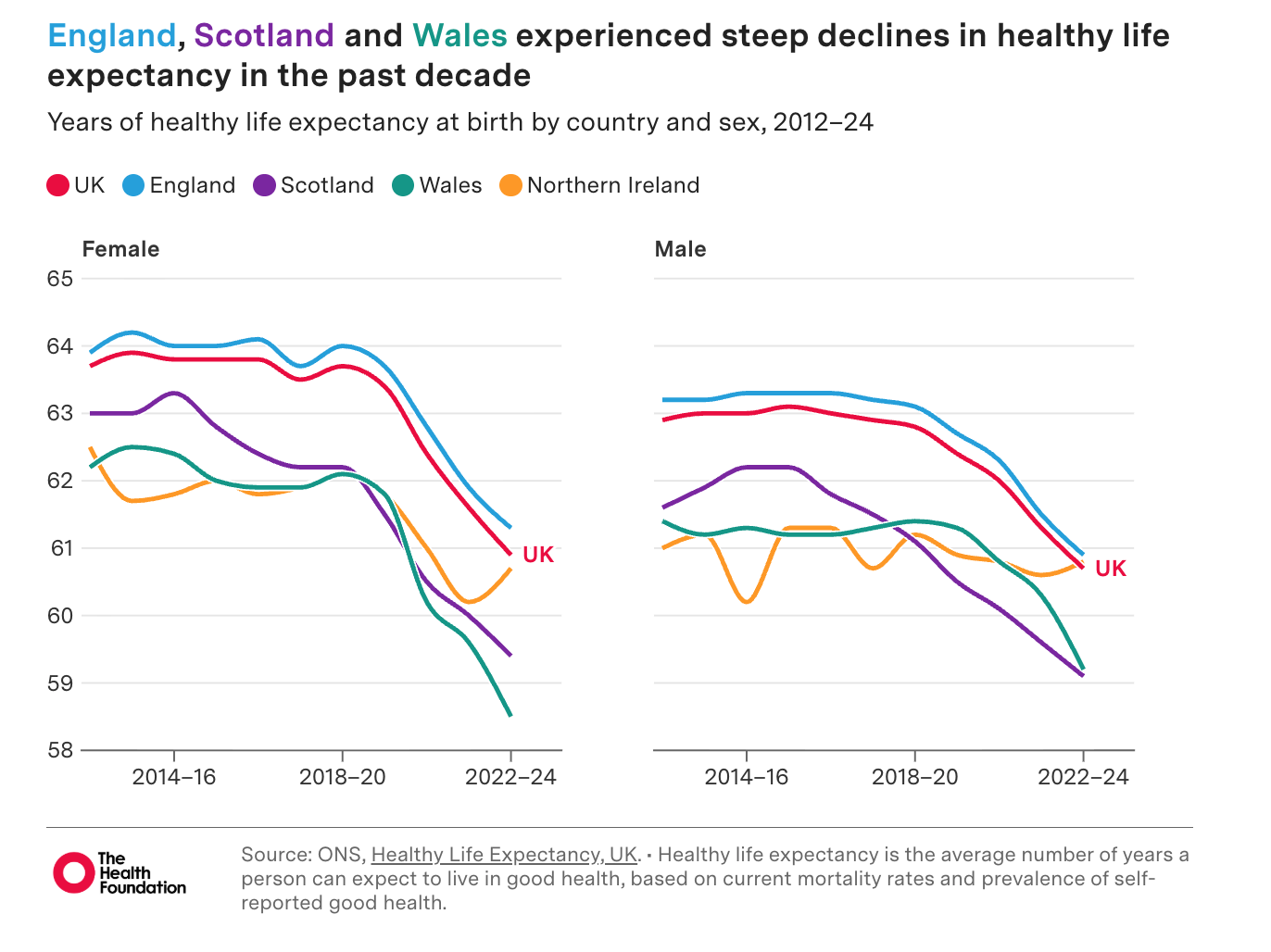
Falling measures of healthy life expectancy by country and sex, 2014-2024
The graphs produced by the Health Foundation caused something of a stir at the time – sloping rapidly downwards, with no sign yet of any break in the fall.
A data analyst writing in the Financial Times a few days after the Health Foundation graphs were published suggested that the drop of two years might be somewhat misleading, in that it was largely driven by younger people’s declining self-reported mental ill-health and rising anxiety, especially among women. However, that still leaves open the question of why younger adults now suffer worse mental health in the UK than they did before, and worse mental health than in many other countries. And it ties back to Coyle’s observation of growing generational divides.
One factor that is frequently mentioned in relation to rising anxiety is concern and uncertainty about the future. In June 2026, data were released suggesting that only 9% of UK pensioners are expected to enjoy a comfortable retirement. Being comfortable is defined as being able to cover annual costs of £31,350 each for two pensioners living together in retirement. Many young adults, even if they have an occupational pension, have almost no prospect of reaching that level of retirement income. Just as importantly, many may have little faith that even if they do try to save money, the systems around them will be fair.
Local government pension contributions by employers have fallen from 21% in 2022 to below 17% by 2025. The excuse for making smaller contributions has been that better investment returns are now being forecast for the assets held by the pension fund, but at least one analyst has warned that: “The important thing is those returns are yet to be earned. They’re not accrued.” This is an example of the kind of action that may be making younger adults fearful for the future.
When the future feels more out of control, it is easier to fear it. In April 2026, the UK government’s statistical agency, the ONS, conducted a survey to measure trust in government. When asked if ‘elections in the UK are fair and democratic’, a narrow majority agreed (51%), just over a quarter were ambivalent (28%), and a fifth (20%) disagreed. That latter proportion rose to 24% for people aged 30–49, the age group most likely to disagree with the statement. Similarly, among people who used social media weekly, the figure was also 24%.
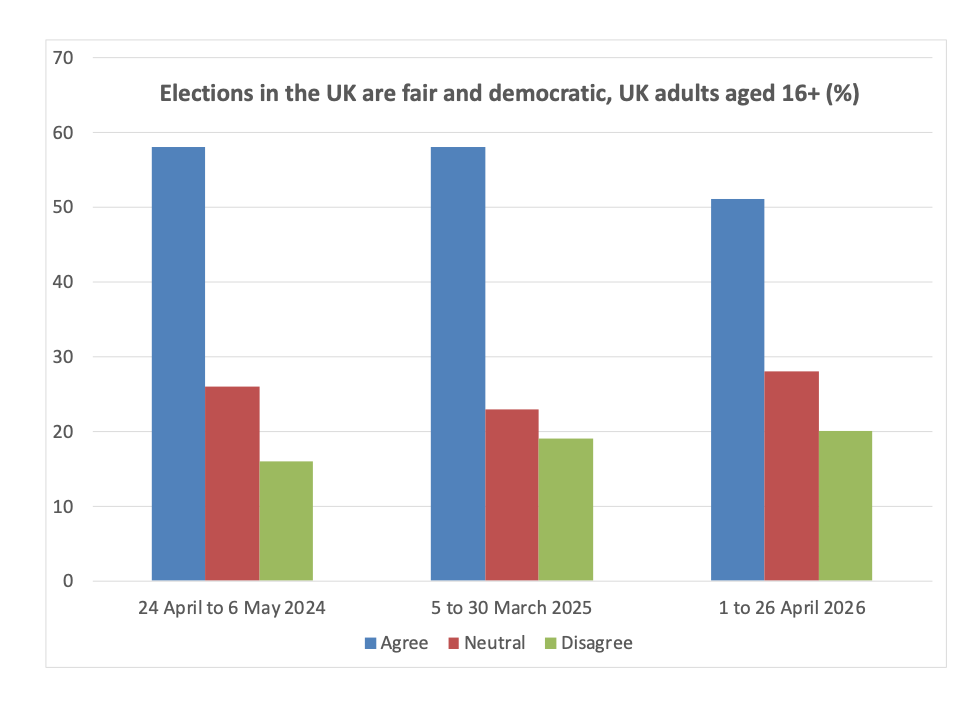
Proportion of adults in the UK who agreed or disagreed with the statement in 2024, 2025 and 2026
When asked to think about future elections in the UK, and “what issues, if any, are you most concerned about?”, of all respondents in April 2026, the three highest concerns were: firstly, 78% concerned about the spread of misinformation, disinformation and ‘fake news’; secondly, 63% concerned about bias in the media; and thirdly, 53% worried about foreign influence on UK election results. These proportions did not alter much across age groups, though men were slightly more likely to be worried than women. When it comes to concerns about elections, the generations are remarkably similar in their concerns, although one age group’s biases may be another’s truths.
The ONS survey was designed to assess whether people who used social media more were more fearful. It did not find much evidence of that, but it did reveal how starkly different generations are in where they receive much of their information. On social media use, only 3% of people aged 16–29 said they did not use social media at all, rising to 12% among ages 30–49, 19% among ages 50–69, and 42% among those aged 70 and over. However, despite such a steep gradient, views on concerns about democracy were similar across ages.
Overall, the proportion agreeing that UK elections were fair and democratic had fallen sharply in the year before April 2026. The change was statistically significant. The next graph shown draws on data from that survey. The change may not look large, but given that it took place in just a year, it shows a rapid hardening in attitudes about not just the stability of the political system, but also its fundamental integrity.
In the aftermath of the May 2026 local elections, the debate about inequality intensified. A former Labour Prime Minister, Tony Blair, published an essay setting out what he would do. The main contender to become the next Labour Prime Minister, Andy Burnham, pointed out that Blair had failed to mention inequality once in his essay and claimed that it was what was ‘driving politics now’.
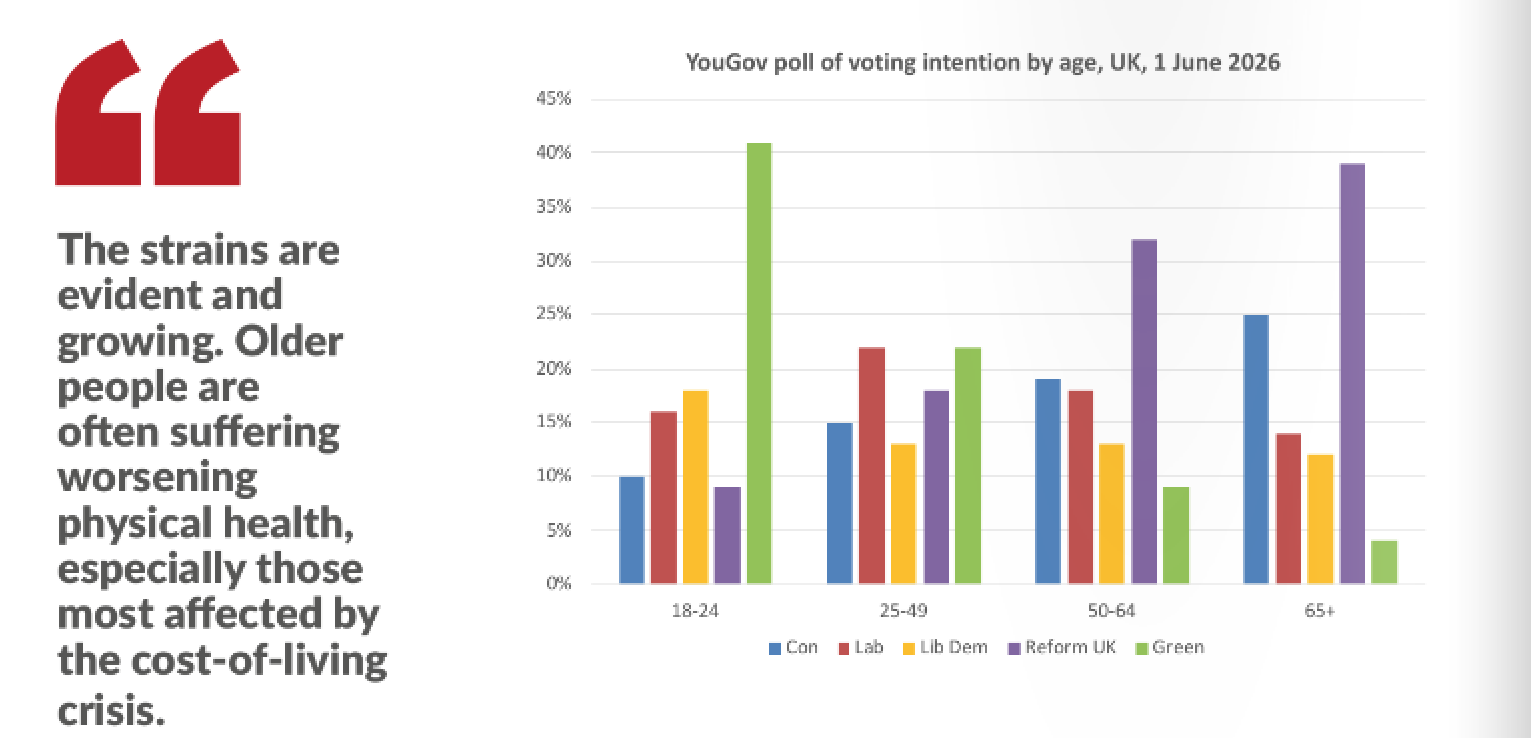
The final graph in this short piece is of the June 1st 2026 snapshot of voting intention by age, taken in the aftermath of those local elections. It is somewhat deceptive in that the 18–24 age group is much smaller than those aged 65 and over. However, with each year that passes, more of the youngest group will move into the next age bracket and more of the oldest will die. But older people are still much more likely to vote than younger people.
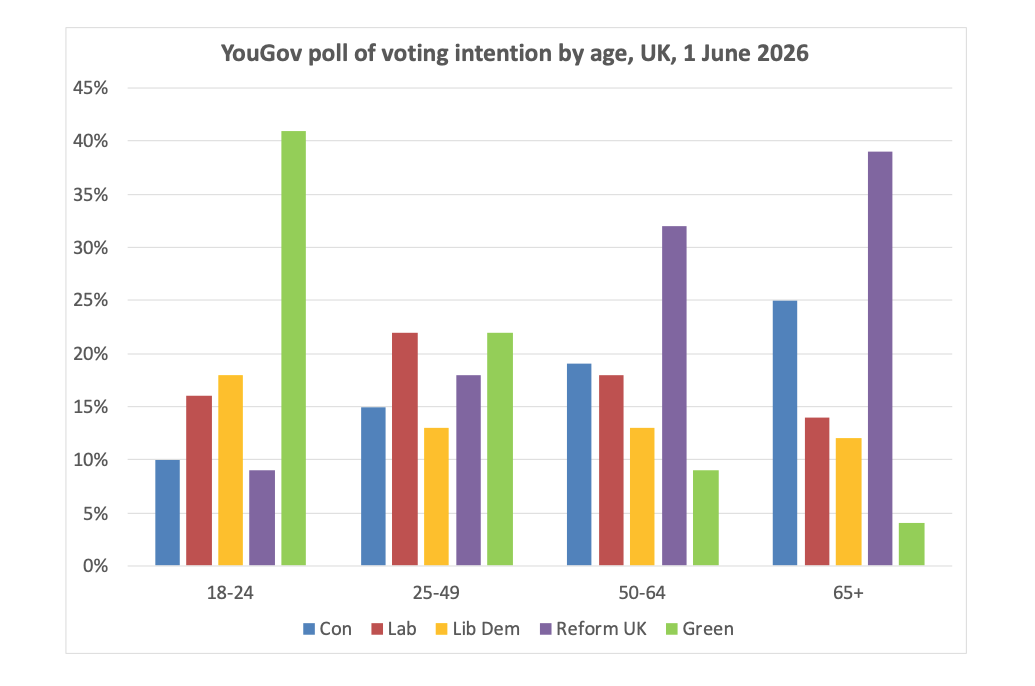
Proportion of adults by age who said they would vote for each party in the Uk in early June 2026
The strains are evident and growing. Older people are often suffering worsening physical health, especially those most affected by the cost-of-living crisis. Younger people are suffering worsening mental health. The young have little faith in the future. The old are increasingly asked to look back to the past. If they do, it might help if they remember that for most of their youth and early adulthood, they lived in, and benefited from, a far more equitable country than the one we live in now.
References
1 https://www.health.org.uk/reports-and-analysis/analysis/healthy-life-expectancy-trends-in-the-uk-a-watershed-moment
2 https://www.pensionsuk.org.uk/news/article/retirement-living-standards-update-shows-the-nation-is-not-saving-enough-
3 https://www.lgcplus.com/lgps/pension-contribution-rates-set-to-fall-by-a-third-20-03-2026/
4https://www.ons.gov.uk/peoplepopulationandcommunity/householdcharacteristics/homeinternetandsocialmediausage/adhocs/3412publicopinionsandsocialtrendsgreatbritainsocialmediaandtrustinelections1to26april2026
5 https://www.bbc.co.uk/news/articles/ckgp4llnn12o
@dannydorling
www.dannydorling.org
For where this article was originally published and a pdf click here.